what happensdoes incresased population due to income distribution
Avant-garde economies also come across a decrease in living standards

The COVID-19 pandemic has created an economic crisis, shuttering businesses and cutting jobs effectually the world. This study looks at how the downturn has afflicted the standard of living globally and in seven major regions.
The focus is on the distribution of people across five income tiers in 2020: poor, depression income, middle income, upper-center income and high income. See the methodology and an earlier Pew Enquiry Center report for more on the definition and significant of these tiers in a global context.
The cardinal data source for the analysis is the World Bank'south PovcalNet database, which provides access to household survey information on either income or consumption for more than than 160 countries. At the regional level, the latest year for which comprehensive information are available ranges from 2014 for South asia to 2018 for East Asia and the Pacific and 3 other regions. The global regions are as defined by the World Banking company.
These benchmark estimates of income are extrapolated to 2020 using World Depository financial institution estimates of output growth through 2020. One project is based on the World Banking company'south Jan 2020 forecasts of economic growth in 2020, and the other is based on its January 2021 estimates of growth in 2020. The difference between these two measures is used to represent the result of the pandemic on the income distribution in each region. Regional estimates are summed to yield estimates of the global distribution.
The COVID-19 pandemic is having a deep effect on the global economy. In January 2020, as reports of the novel coronavirus were emerging, the Globe Banking concern forecasted that the global economy would aggrandize by 2.five% that year. In January 2021, with the pandemic still holding much of the world in its grip, the World Bank estimated that the global economy contracted past iv.three% in 2020, a turnabout of half dozen.eight percentage points.
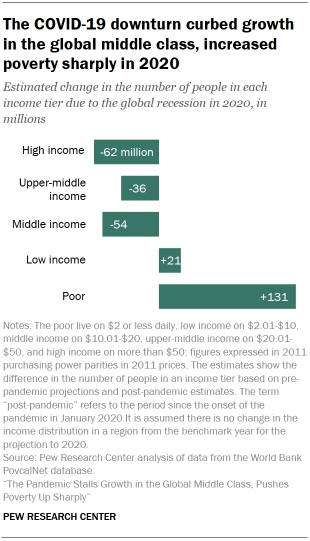
The economic downturn is likely to accept diminished living standards around the world, pushing millions out of the global centre class and swelling the ranks of the poor. At the same fourth dimension, the path to a recovery is overcast with uncertainties.
A new Pew Research Eye analysis finds that the global heart class encompassed 54 million fewer people in 2020 than the number projected prior to the onset of the pandemic. Meanwhile, the number of poor is estimated to have been 131 million college considering of the recession.
The drop-off in the global middle form was centered in South Asia and in East Asia and the Pacific, and it stalled the expansion seen in the years preceding the pandemic. South Asia, specifically Bharat, along with Sub-Saharan Africa, accounted for most of the increase in poverty, reversing years of progress on this front.
As defined in this written report (and in previous Pew Research Center analyses), people who are middle income live on $10.01-$20 a twenty-four hours, which translates to an annual income of about $fourteen,600 to $29,200 for a family of four. This is small-scale by the standards of advanced economies. In fact, it straddles the official poverty line in the United States – nigh $23,000 for a family of four in 2020 (expressed in 2011 prices). Past global standards, the poor live on $2 or less a day, or no more than $2,920 annually for a family of four.
The number of people in the global high-income tier (more than than $fifty daily) is estimated to have decreased by 62 million in 2020, erasing near half of the gain since 2011, with well-nigh of the change emanating from advanced economies. Meanwhile, the upper-middle income population ($20.01-$fifty daily) fell by 36 million, while the low-income population ($ii.01-$ten daily) is estimated to have increased by 21 million.
Who is middle form (or middle income)?
This report uses the terms "middle income" and "middle class" interchangeably, a common practice among economists who tend to define the middle class in terms of income or consumption. But being middle class tin connote more than income, be it a higher education, white-neckband work, economic security, owning a home, or having certain social and political values. Form could also simply be a matter of self-identification. The coaction among these many factors is examined in studies past Hout (2007) and Savage et al. (2013), amongst others.
The population in each global region is divided into five groups: poor, low income, middle income, upper-middle income and high income. The poor live on $2 or less daily, low income on $two.01-$10, center income on $10.01-$xx, upper-middle income on $xx.01-$50 and high income on more $l. All dollar figures are expressed in 2011 prices and purchasing ability parity dollars, currency commutation rates adjusted for differences in the prices of goods and services across countries.
The assignment to a group, or income tier, is based on a household's daily per capita income or consumption, a simple way of controlling for differences in household size. In the source data, some countries merely report income information while others only written report consumption data. The terms "income" and "consumption" are used interchangeably for the sake of convenience.
A middle-income, or center-grade, threshold of $10 follows the exercise of other researchers. A similar threshold has been used by the World Depository financial institution (2007, 2015), researchers at the Organization for Economic Cooperation and Development (Kharas, 2010), the development community (Birdsall, Lustig and Meyer, 2013) and others. At that place is show that the $x threshold, which is almost five times higher than the Earth Depository financial institution'due south global poverty line, is associated with economic security and "insulates" people from falling back into poverty. An earlier Pew Research Center study discusses the choice of income thresholds in greater item.
The global center-grade standard is modest by the standards of avant-garde economies. In 2020, the official poverty line for a family unit of four in the U.S. stood at about $15.ninety per person per 24-hour interval (in 2011 prices). Thus, many who are poor by the U.South. definition would meet the global middle-income standard or, conversely, many who are in the global middle class would be poor by U.S. standards.
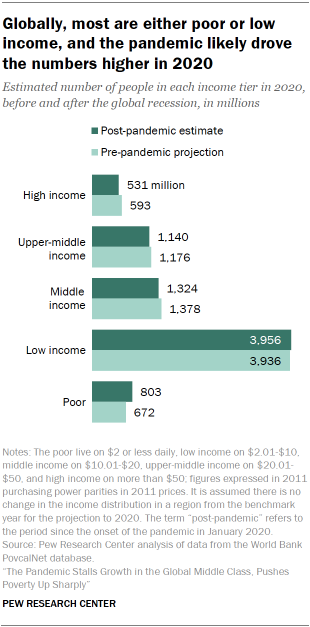
These estimates are based on the Center'southward analysis of Earth Bank data on the distribution of people past either income or consumption levels in seven major global regions. The latest available estimates of income for each region, such as for 2018 for Europe and Primal Asia and 2015 for the Middle East and North Africa, are extrapolated to 2020 using two sets of growth estimates: the forecasts issued past the World Banking concern in January 2020, prior to the pandemic, and the estimates issued in January 2021, with the pandemic's economical bear upon in plainer sight. The difference betwixt these two measures is taken to represent the impact of the COVID-xix downturn on the standard of living of people globally.
Prior to the emergence of COVID-xix, some 1.38 billion people were expected to exist counted in the global middle course in 2020. Just the pandemic is estimated to take driven this number down to 1.32 billion. The share of people in the middle class globally is estimated to accept been 17.one% in 2020, instead of potentially 17.viii%. The erosion in the middle course might have been deeper if not for the fact that Red china – which is home to more than one-tertiary of the global middle class – evaded an economic contraction, fifty-fifty though growth there was slower than predictable.
The number of global poor is estimated to have risen to 803 one thousand thousand in 2020, much greater than the 672 one thousand thousand initially expected. The global poverty rate, which had been in steady decline this century, is likely to accept increased to x.iv%, virtually reverting to the rate in 2017, instead of sinking to a new low of 8.7%, as previously expected.
The steep rise in global poverty is driven by the fact that many who were in the low-income tier prior to the pandemic lived on the margin of poverty. In 2017, 877 million people lived on $ii to $3 a 24-hour interval, according to World Bank estimates. Thus, large numbers were susceptible to falling back into poverty prior to the pandemic, especially in South Asia and Sub-Saharan Africa.
At the other finish of the economical spectrum, the global high-income population likely fell to 531 meg in 2020 from the 593 million originally expected. Consequently, the expected share in the high-income tier is 6.8%, non 7.6%. A vast bulk of the global high-income population lives in avant-garde economies, and this grouping of countries likewise experienced a sharp downturn in 2020. Ironically, this bolstered the global center-income population every bit people in avant-garde economies slipped down the ladder from college income tiers.
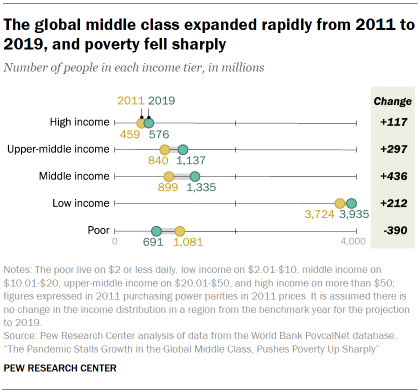
The reversal in global living standards in 2020 comes on the heels of notable progress before in the decade. From 2011 to 2019, the global centre-class population increased from 899 million to one.34 billion, or past 54 1000000 people annually, on average. The pandemic is estimated to have erased a twelvemonth of growth, leaving the global center-grade population nearly unchanged from 2019 to 2020.
Global poverty had abated at an boilerplate rate of 49 million annually from 2011 to 2019, with the number of global poor falling from one.10 billion to 691 million during this period. The pandemic, by adding 131 million to the ranks of the poor, has fix the progress on poverty back by several years, and the poverty rate is estimated to have increased from 9.0% in 2019 to x.4% in 2020.
From 2011 to 2019, the global high-income population had increased from 459 million to 576 one thousand thousand, growing by an boilerplate of 15 one thousand thousand annually. Thus, the setback of 62 million due to the pandemic in 2020 also reverses several years of growth in the loftier-income population. The share of the global population in the high-income tier is expected to accept decreased from 7.5% in 2019 to six.8% in 2020.
The erosion of the middle course is centered in Asia, the rise in poverty in Asia and Africa
The effect of the COVID-19 downturn on the middle form and other income tiers shows distinct regional differences. Asia is expected to have deemed for virtually of the shrinking of the global middle class in 2020, with the middle-class population falling by 32 meg in Southern asia and past 19 million in East Asia and the Pacific. Meanwhile, the heart form in advanced economies is estimated to have increased past sixteen million, in part due to the driblet-off in the loftier-income tier in those countries.
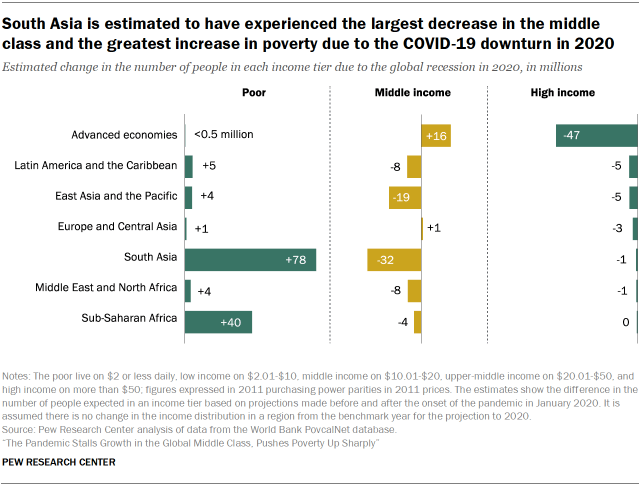
The projected ascension in global poverty in the pandemic is full-bodied in S Asia (an increase of 78 1000000) and Sub-Saharan Africa (40 meg), historically among the poorest regions in the world. The high-income population in advanced economies is estimated to accept shrunk past 47 meg in 2020, accounting for most of the falloff globally. It should be noted that the global cutoff for the high-income tier – more $50 a day – is not much college than the median income beyond advanced economies, as an estimated 40% of the population in these countries is in the global loftier-income tier. Thus, the wrinkle of the loftier-income tier in avant-garde economies is more a reflection of the reduction in the standard of living of the typical person in these countries than outcomes for the wealthy.
The contribution of a region to global changes overall and the shift in its own income distribution depends mostly on two factors: the sizes of income tiers in the region prior to the COVID-19 recession and the bear on of the downturn on economic growth in the region.
Prior to the pandemic, nigh half of the global middle-class population – 672 million of 1.38 billion – was estimated to live in East Asia and the Pacific, a region that includes China. Latin America and the Caribbean accounted for 191 million, and Europe and Central Asia was home to 183 million. South Asia accounted for 123 1000000 more than.
In view of these magnitudes, the estimated loss (relative to pre-pandemic expectations) of 32 million people from the heart class in South asia is notable for 2 reasons. Commencement, the region contributed the about to the shrinking of the global eye grade in 2020 despite having a centre-income population smaller than several other regions. Second, the percentage subtract in South Asia'due south middle-income population from what was previously expected (26%) is much greater than in any other region. Although Due east Asia and the Pacific shed 19 one thousand thousand from the middle-income tier, that represented but 3% of its middle class.
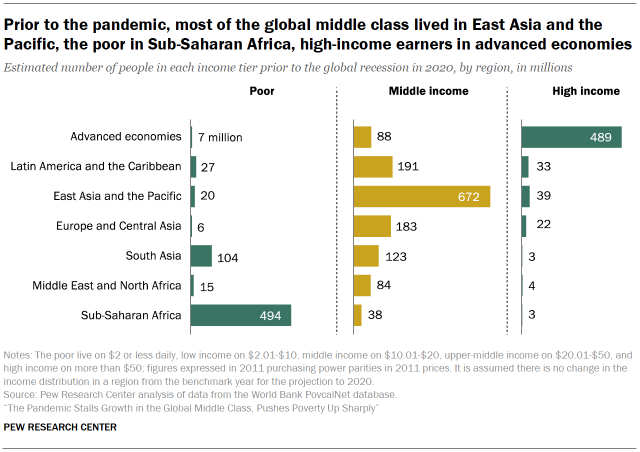
Poverty is most prevalent in Sub-Saharan Africa. Some 494 million people in Sub-Saharan Africa, out of a full population of 1.14 billion, were expected to be living in poverty ahead of the pandemic in 2020. South Asia, with a total population of 1.86 billion, was expected to be abode to 104 million poor. Notwithstanding, South asia is estimated to have added nearly double the corporeality of people to the ranks of the globally poor equally Sub-Saharan Africa in the pandemic. The percentage increment in poverty in South asia (75%) dwarfs the increase in Sub-Saharan Africa (8%).
The number of poor in other regions was smaller, estimated to range from 6 million in Europe and Central Asia to 27 million in Latin America and the Caribbean ahead of the pandemic in 2020. But, since that moment, the increase in poverty in these regions is notable. The Middle East and North Africa and East Asia and the Pacific are each estimated to accept seen increases in poverty of more than twenty% due to the recession. The rise in poverty in both Europe and Primal Asia and Latin America and the Caribbean is not far behind, with each experiencing a 17% increase in poverty.
A big majority of the global high-income population – 489 1000000 of 593 million – lived in advanced economies before the global recession took concur. The estimated decrease of 47 million, or ten%, in this population in advanced economies accounts for most of the shrinking of the global loftier-income tier.
In proportional terms, the drop off in the high-income tier is too notable in Latin America and the Caribbean (15%), Europe and Central Asia (12%) and Eastward Asia and the Pacific (12%). The losses in the Middle E and Northward Africa, Southern asia and Sub-Saharan Africa are relatively pocket-sized in magnitude (each less than 1 million people) but also represent double-digit shares of the high-income populations in those regions.
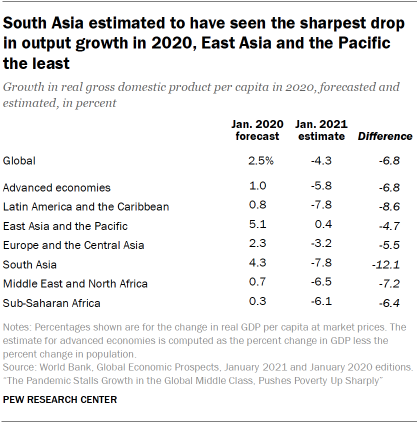
The relatively outsized role of South asia in the contraction of the global middle form and the expansion of poverty is the result of it seeing the sharpest reduction in economical growth in the pandemic. In Jan 2020, the World Banking concern forecasted that Due south Asia would experience a 4.3% increment in gross domestic product (GDP) per capita in 2020. But, in Jan 2021, output in Southern asia was estimated to have decreased by 7.8% in 2020, a retreat of 12.one percentage points from potential.
The setback to economic growth in other regions is smaller, ranging from 4.7 percentage points in East asia and the Pacific to 8.6 points in Latin America and the Caribbean area. Eastern asia and the Pacific is the only region in which growth is estimated to have stayed positive in 2020, with GDP per capita inching upwards by 0.iv% even after the onset of the pandemic. Otherwise, the latest estimates of the change in output per capita in 2020 ranged from -three.two% in Europe and Fundamental Asia to -seven.8% in Latin America and the Caribbean.
matthewsthenteme1974.blogspot.com
Source: https://www.pewresearch.org/global/2021/03/18/the-pandemic-stalls-growth-in-the-global-middle-class-pushes-poverty-up-sharply/
0 Response to "what happensdoes incresased population due to income distribution"
إرسال تعليق