Acting With the Voice the Art of Recording Books

Art Carden is an Assistant Professor of Economic science and Business at Rhodes Higher in Memphis, Tennessee. Read total profile
⌄ Scroll down to continue ⌄
Josh Waitzkin has led a total life as a chess master and international martial arts champion, and as of this writing he isn't yet 35. The Art of Learning: An Inner Journey to Optimal Performance chronicles his journey from chess prodigy (and the subject of the moving picture Searching for Bobby Fischer) to earth title Tai Chi Chuan with of import lessons identified and explained along the way.
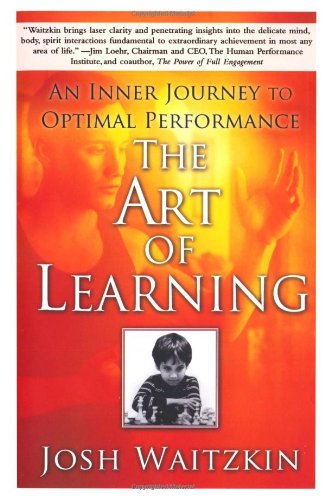
Marketing expert Seth Godin has written and said that one should resolve to alter three things as a result of reading a business volume; the reader volition find many lessons in Waitzkin's book. Waitzkin has a list of principles that appear throughout the book, but information technology isn't always clear exactly what the principles are and how they tie together. This doesn't really hurt the book'south readability, though, and information technology is at best a minor inconvenience. There are many lessons for the educator or leader, and equally ane who teaches college, was president of the chess guild in middle schoolhouse, and who started studying martial arts about 2 years ago, I found the book engaging, edifying, and instructive.
Waitzkin's chess career began among the hustlers of New York'south Washington Square, and he learned how to concentrate amid the noise and distractions this brings. This experience taught him the ins and outs of aggressive chess-playing too as the importance of endurance from the cagey players with whom he interacted. He was discovered in Washington Square by chess teacher Bruce Pandolfini, who became his first coach and developed him from a prodigious talent into ane of the best immature players in the world.
The book presents Waitzkin'southward life as a study in contrasts; perhaps this is intentional given Waitzkin'south admitted fascination with eastern philosophy. Among the most useful lessons business organisation the aggression of the park chess players and young prodigies who brought their queens into the action early or who ready elaborate traps and so pounced on opponents' mistakes. These are splendid ways to quickly dispatch weaker players, merely it does not build endurance or skill. He contrasts these approaches with the attention to item that leads to 18-carat mastery over the long run.
⌄ Scroll down to continue reading article ⌄
⌄ Scroll downwardly to proceed reading article ⌄
According to Waitzkin, an unfortunate reality in chess and martial arts—and maybe by extension in education—is that people larn many superficial and sometimes impressive tricks and techniques without developing a subtle, nuanced control of the key principles. Tricks and traps tin impress (or vanquish) the credulous, just they are of express usefulness against someone who actually knows what he or she is doing. Strategies that rely on quick checkmates are likely to falter against players who can deflect attacks and get 1 into a long heart-game. Swell junior players with four-move checkmates is superficially satisfying, but information technology does niggling to improve one's game.
He offers ane child equally an anecdote who won many games confronting junior opposition just who refused to encompass existent challenges, settling for a long string of victories over clearly inferior players (pp. 36-37). This reminds me of advice I got from a friend recently: always endeavour to make sure you're the dumbest person in the room so that y'all're e'er learning. Many of usa, though, draw our cocky-worth from being large fish in small ponds.
Waitzkin's discussions cast chess as an intellectual boxing lucifer, and they are particularly apt given his discussion of martial arts later in the volume. Those familiar with boxing will recollect Muhammad Ali's strategy confronting George Foreman in the 1970s: Foreman was a heavy hitter, but he had never been in a long bout before. Ali won with his "rope-a-dope" strategy, patiently arresting Foreman'south blows and waiting for Foreman to exhaust himself. His lesson from chess is apt (p. 34-36) as he discusses promising young players who focused more intensely on winning fast rather than developing their games.
Waitzkin builds on these stories and contributes to our understanding of learning in chapter ii by discussing the "entity" and "incremental" approaches to learning. Entity theorists believe things are innate; thus, ane can play chess or do karate or exist an economist because he or she was built-in to practise and so. Therefore, failure is deeply personal. By contrast, "incremental theorists" view losses equally opportunities: "footstep by footstep, incrementally, the novice can become the principal" (p. 30). They ascension to the occasion when presented with difficult cloth because their arroyo is oriented toward mastering something over time. Entity theorists collapse nether pressure. Waitzkin contrasts his approach, in which he spent a lot of time dealing with end-game strategies
where both players had very few pieces. By contrast, he said that many young students begin past learning a wide assortment of opening variations. This damaged their games over the long run: "(thou)any very talented kids expected to win without much resistance. When the game was a struggle, they were emotionally unprepared." For some of us, pressure becomes a source of paralysis and mistakes are the beginning of a down spiral (pp. 60, 62). As Waitzkin argues, however, a dissimilar approach is necessary if we are to reach our total potential.
A fatal flaw of the shock-and-awe, blitzkrieg approach to chess, martial arts, and ultimately anything that has to be learned is that everything can exist learned by rote. Waitzkin derides martial arts practitioners who become "form collectors with fancy kicks and twirls that have absolutely no martial value" (p. 117). One might say the same affair about problem sets. This is not to gainsay fundamentals—Waitzkin's focus in Tai Chi was "to refine certain primal principles" (p. 117)—only there is a profound departure between technical proficiency and true agreement. Knowing the moves is one thing, but knowing how to determine what to do next is quite another. Waitzkin's intense focus on refined fundamentals and processes meant that he remained strong in later on round while his opponents withered. His approach to martial arts is summarized in this passage (p. 123):
⌄ Gyre downwards to proceed reading article ⌄
⌄ Scroll downward to continue reading article ⌄
"I had condensed my body mechanics into a potent land, while most of my opponents had big, elegant, and relatively impractical repertoires. The fact is that when there is intense contest, those who succeed have slightly more than honed skills than the rest. Information technology is rarely a mysterious technique that drives u.s.a. to the top, but rather a profound mastery of what may well be a basic skill set. Depth beats breadth whatever day of the week, because information technology opens a channel for the intangible, unconscious, creative components of our subconscious potential."
This is about much more than smelling claret in the water. In chapter 14, he discusses "the illusion of the mystical," whereby something is so clearly internalized that almost imperceptibly small movements are incredibly powerful as embodied in this quote from Wu Yu-hsiang, writing in the nineteenth century: "If the opponent does not move, then I do not motility. At the opponent's slightest move, I motility first." A learning-centered view of intelligence means associating endeavor with success through a process of instruction and encouragement (p. 32). In other words, genetics and raw talent tin only get yous and then far before hard work has to pick up the slack (p. 37).
Another useful lesson concerns the employ of adversity (cf. pp. 132-33). Waitzkin suggests using a trouble in one expanse to adapt and strengthen other areas. I accept a personal example to back this up. I volition always regret quitting basketball in loftier school. I recollect my sophomore year—my terminal twelvemonth playing—I broke my thumb and, instead of focusing on cardiovascular workout and other aspects of my game (such as working with my left mitt), I waited to recover earlier I got back to work.
Waitzkin offers some other useful chapter entitled "slowing down time" in which he discusses ways to sharpen and harness intuition. He discusses the process of "chunking," which is compartmentalizing issues into progressively larger issues until one does a complex set of calculations tacitly, without having to call up about information technology. His technical instance from chess is particularly instructive in the footnote on page 143. A chess grandmaster has internalized much almost pieces and scenarios; the grandmaster can process a much greater amount of information with less effort than an expert. Mastery is the process of turning the articulated into the intuitive.
There is much that will be familiar to people who read books like this, such as the need to pace oneself, to set clearly divers goals, the need to relax, techniques for "getting in the zone," then forth. The anecdotes illustrate his points beautifully. Over the grade of the book, he lays out his methodology for "getting in the zone," another concept that people in performance-based occupations will discover useful. He calls information technology "the soft zone" (chapter three), and it consists of existence flexible, malleable, and able to adapt to circumstances. Martial artists and devotees of David Allen's Getting Things Washed might recognize this as having a "mind like water." He contrasts this to "the hard zone," which "demands a cooperative world for you to office. Like a dry out twig, y'all are brittle, ready to snap nether pressure" (p. 54). "The Soft Zone is resilient, like a flexible bract of grass that tin movement with and survive hurricane-forcefulness winds" (p. 54).
⌄ Scroll downwards to keep reading article ⌄
⌄ Scroll downwards to go on reading article ⌄
Some other illustration refers to "making sandals" if one is confronted with a journeyacross a field of thorns (p. 55). Neither bases "success on a submissive globe or overpowering force, just on intelligent preparation and cultivated resilience" (p. 55). Much here will be familiar to creative people: you lot're trying to think, but that 1 song by that ane band keeps blasting away in your caput. Waitzkin'south "simply option was to go at peace with the noise" (p. 56). In the linguistic communication of economics, the constraints are given; we don't go to cull them.
This is explored in greater detail in chapter 16. He discusses the height performers, Michael Jordan, Tiger Woods, and others who do not obsess over the final failure and who know how to relax when they demand to (p. 179). The experience of NFL quarterback Jim Harbaugh is also useful equally "the more he could let things go" while the defense was on the field, "the sharper he was in the next drive" (p. 179). Waitzkin discusses further things he learned while experimenting in human operation, peculiarly with respect to "cardiovascular interval grooming," which "tin can take a profound effect on your ability to chop-chop release tension and recover from mental exhaustion" (p. 181). It is that last concept—to "recover from mental burnout"—that is likely what well-nigh academics need assistance with.
There is much here near pushing boundaries; however, one must earn the right to exercise so: as Waitzkin writes, "Jackson Pollock could describe similar a photographic camera, simply instead he chose to splatter paint in a wild manner that pulsed with emotion" (p. 85). This is another proficient lesson for academics, managers, and educators. Waitzken emphasizes shut attending to detail when receiving education, peculiarly from his Tai Chi teacher William C.C. Chen. Tai Chi is non about offering resistance or force, merely about the ability "to blend with (an opponent's) energy, yield to it, and overcome with softness" (p. 103).
The volume is littered with stories of people who didn't reach their potential because they didn't seize opportunities to improve or because they refused to arrange to conditions. This lesson is emphasized in chapter 17, where he discusses "making sandals" when confronted with a thorny path, such as an underhanded competitor. The book offers several principles by which we can become amend educators, scholars, and managers.
Jubilant outcomes should be secondary to jubilant the processes that produced those outcomes (pp. 45-47). In that location is also a written report in contrasts kickoff on page 185, and it is something I have struggled to learn. Waitzkin points to himself at tournaments being able to relax between matches while some of his opponents were pressured to analyze their games in between. This leads to farthermost mental fatigue: "this tendency of competitors to exhaust themselves between rounds of tournaments is surprisingly widespread and very self-destructive" (p. 186).
⌄ Scroll downwards to continue reading commodity ⌄
⌄ Ringlet downward to continue reading article ⌄
The Art of Learning has much to teach us regardless of our field. I found it particularly relevant given my chosen profession and my decision to start studying martial arts when I started teaching. The insights are numerous and applicable, and the fact that Waitzkin has used the principles he now teaches to become a world-class competitor in two very demanding competitive enterprises makes it that much easier to read.
I recommend this book to anyone in a position of leadership or in a position that requires extensive learning and adaptation. That is to say, I recommend this volume to everyone.
More About Learning
- thirteen Ways to Develop Self-Directed Learning and Learn Faster
- How to Learn Fast and Remember More than: 5 Effective Techniques
- How to Create an Effective Learning Process And Learn Smart
Featured photo credit: Jazmin Quaynor via unsplash.com
matthewsthenteme1974.blogspot.com
Source: https://www.lifehack.org/articles/lifehack/a-review-of-the-art-of-learning.html
0 Response to "Acting With the Voice the Art of Recording Books"
إرسال تعليق