Ugh Now I Want to Watch the Lorax Again.
1.
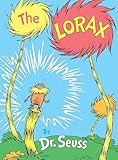 The movie adaptation of The Lorax opens on March 2d, Dr. Seuss' birthday. His xanthous-mustached crusader at present appears on countless billboards and buses, and stars in environmentally witting ads. I'k pleased that the grumpy guy is getting and so much attending. He speaks for the trees (the Truffula Trees!), and the Humming-Fish, and the Swomee-Swans, and the Brown Bar-ba-loots. A good creature. An important message. A powerful ally in the fight against Gluppity-Glupp and smogulous fume, the byproducts of Thneed overproduction.
And then information technology upset me when I heard that in 1989 a group of parents tried to censor The Lorax. They took out a full-folio newspaper advertizing accusing 2nd-grade teachers of brainwashing students. Who would practice that? Only someone who doesn't understand the value of free speech, right?
Before laying into logger Bill Bailey of Laytonville, Calif., and his supporters, I'm going to enquire you lot to consider a different book — Alfie'south Abode, published four years after The Lorax came under burn. It tells the story of a male child named Alfie whose male parent is "working all the time, and when he's at domicile, he screams a lot." Into this paternal void steps Uncle Pete: "One nighttime when he was holding me, he started touching my private parts. Over time, he taught me to touch and play with his. It felt very strange, scary, and a petty good too."
Young Alfie comes to believe he is gay, a "confusion" exacerbated past "the other guys" at school who call him names similar "'Sissy, 'Faggot,' 'Queer,' 'Human.'" But the volume ends on what it presents as a positive note. Alfie seeks counseling and learns that he was only looking for closeness with other boys to fill the need for "Dad'southward love." Anybody lives happily ever after, including Alfie's parents, who, thanks to the same African-American advisor, manage to cultivate a loving relationship with each other and their son.
Needless to say, Alfie's Home (past "ex-gay" Richard A. Cohen) does not appear in many libraries, much less on 2d-grade required reading lists (as The Lorax did for the Laytonville Unified School District). For me that's far from a regrettable absence. But why? Am I a closet censor, ready to suppress repugnant ideologies while trumpeting the importance of Banned Books Calendar week?
The brusk answer is aye. Fortunately, books I observe disgusting simply don't become purchased by libraries or required by schools, saving me, and other like-minded individuals, from the embarrassing and hypocritical chore of challenging them.
2.
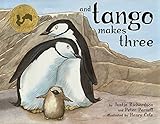 My home town of Chicago does non have its public schoolhouse library catalogue online, but a search of the New York and Portland catalogues shows multiple copies of And Tango Makes Three (and Tres Con Tango), a moving picture-book about 2 male chinstrap penguins who raise an egg together at New York's Key Park Zoo. According to the ALA, And Tango Makes 3 was the most challenged book from 2006 to 2010 (except for 2009 when information technology came it second). Tango is bully as far as I'chiliad concerned, simply not everyone feels the aforementioned way. You know who I mean — the people, generally conservative, who runway against everything from Roald Dahl's The Witches to Judy Blume. Religion is oftentimes in the mix — one group of censorial parents and students in Oceanside, Calif., was really called the "God Squad." (A classic boxing: D.T. Suzuki'due south Zen Buddhism: Selected Writings was challenged in County, Mich., because "this volume details the teachings of the religion of Buddhism in such a way that the reader could very probable embrace its teachings and cull this every bit his religion.")
Alfie's Dwelling house never made the ALA's list of most challenged books. Not because liberals are happy to see information technology sharing shelf space with The Lorax, though, but rather because libraries aren't willing to stock information technology, and teachers would never assign information technology if they did. For good reason, too. There's an like shooting fish in a barrel, not-ideological argument to be made against Alfie'due south Dwelling house — aesthetically, it'south a disaster. To quote the Schoolhouse Library Journal review: "Everything nigh this book screams fake. The illustrations are flat and garish in their simplicity, lacking any personality or entreatment. If the generic illustrations aren't a complete turnoff, the saccharine tone of the writing gives further challenge to credibility. If readers were able to ignore the presentation, at that place is still the message of the text to choke them. A boy from a dysfunctional family unit who is abused throughout his babyhood and into his teens sees a counselor and everything is all of a sudden wonderful."
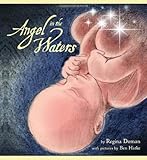 But what nigh a much, much amend volume, Regina Doman's Angel in the Waters? Exquisitely illustrated past Ben Hatke (whose Zita the Spacegirl does appear in the New York and Portland catalogues), the book is a poetic paean to man development, starting at the moment of conception: "In the beginning, I was./I was for a long time. Then things began to happen." Why don't the Portland and New York libraries stock any copies of Angel? And why isn't it on any schoolhouse reading lists?
There are a number of plausible reasons: educators just aren't familiar with information technology, or don't think it is popular plenty to purchase. Let me suggest an boosted reason — many librarians and teachers don't want young, impressionable children reading near anthropomorphized fetuses that have an "Angel" and talk in the first person. Nor exercise they desire to reinforce the (simulated?) notion that babies somehow remember their early time in the womb: "Sometimes, when I am in my bath, I remember the waters, and swimming." It feels too much like pro-life indoctrination, no matter how overnice the writing and illustrations. (At to the lowest degree that's how information technology feels to me.)
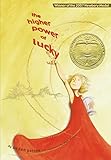 The fact is, when censorship fits with i'south values, even the staunchest defenders of gratis speech are willing to curve the rules. Take the ALA, peradventure the most vociferous opponents of censorship in America. Through the Association for Library Service to Children, they administrate the prestigious Newbery Medal, awarded to countless banned and challenged classics. In 2007, The New York Times reported how the ALA cried censorship when some librarians foresaw pressure level from parents and refused to purchase 2007 Newbery winner The Higher Power of Lucky. The reason? "Scrotum" appears on the first page of the book. Presumably requests to publish a bowdlerized version without the offensive word would accept met with similar disapprobation. Bourgeois mores getting in the manner of free spoken communication withal once again.
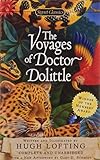 What's foreign, notwithstanding, is that the Newbery honor is still allowed on the encompass of Hugh Lofting's The Voyages of Dr. Dolittle. Both Dell Yearling and HarperCollins published Voyages in a highly censored form of the 1922 award-winning original (and the aforementioned is true of its predecessor, The Story of Dr. Dolittle.) Concerned with racially insensitive cloth, editors at each publishing house saw fit to expunge potentially offensive slurs, rewrite or delete stereotypical depictions of Africans, and replace illustrations of black characters.
None of this is described explicitly as censorship. In the afterword to HarperCollins' The Story of Dr. Dolittle, the editorial changes are referred to every bit "gentle revision." And in the afterword to the Dell Yearling version of Voyages, Christopher Lofting, the author's son, writes: "Book banning or censorship is not an American tradition! To change the original could be interpreted every bit censorship. So again, and then could a determination to deny children access to an entire series of classics on the basis of isolated passing references." There are references in both editions to the certain approval of Hugh Lofting, were he just live to give information technology. (KSU professor Philip Nel has an splendid discussion of Dr. Dolittle, along with Roald Dahl's Oompa-Loompas, who used to be African pygmies.)
Of course, if yous worry less about racism or homophobia and more than about anti-religious indoctrination or anti-backer sentiment, in that location will be an entirely different set of books you lot desire off readings lists, and themes you lot want out of books. Which brings the states back to logger (actually logging equipment manufacturer) Bill Bailey and The Lorax. According to People mag, Bailey institute out well-nigh the book when his son Sammy came abode, distraught. "If you cutting down a tree," Sammy told his father, "then it'south just like someone coming in and taking away your dwelling." Ouch.
At present it's clear to me The Lorax isn't an anti-logging book so much as a plea for the environment. Theodore Geisel agrees: "The Lorax doesn't say lumbering is immoral. I alive in a business firm fabricated of woods and write books printed on paper. It'southward a book about going easy on what we've got. It'southward antipollution and antigreed." But that'southward non really the betoken. Angel in the Waters might not be meant to convince young children that abortion is evil. Even so, imagine a woman deciding whether or not to have an abortion. Her vii-year-old daughter comes domicile from school one day and tells her that, from the very moment of conception, babies can think and take angels. One of her classmates told her how some parents murder those babies. Is that true, she asks? Practice people actually murder their babies and their angels?
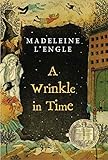 If I were that mother, I would exist devastated. And if I institute out Affections in the Waters was somehow behind my child's questions, there's a good chance I'd ask for information technology to be removed from a required reading list. Depending on how upset I was, I might even challenge its presence in the library. And I'd rationalize that claiming: "It's non censorship. It's separation of church building and state. This is a public school, religion shouldn't be taught here, especially not to very immature children." (I wouldn't retrieve likewise hard about the religious overtones of A Wrinkle in Fourth dimension, and whether ecumenical spirituality even so belongs in schools.)
three.
Stanley Fish likes to remind united states there is no such affair every bit costless speech, even in America, and points out that censorship in the colloquial sense happens all the time: "Censorship occurs whenever nosotros don't say or write something because nosotros fear adverse consequences, or because we feel that what nosotros would like to say is inappropriate in the circumstances, or because we don't want to injure someone's feelings. (This is ofttimes chosen self-censorship. I call it civilized behavior.)" When a library rejects a book, or a school deems material inappropriate for a reading list, it is a class of censorship that is widespread and inevitable, which Fish calls "judgment." Such censorship can be based on aesthetics — this book is bad, truth — this book is wrong, or ethics — this book is Wrong.
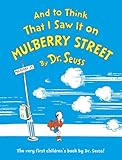 (Interestingly, Dr. Seuss engaged in a chip of self-censorship based on truth and ethics. After pressure from enquiry assembly in the Ohio Sea Grant program, he acknowledged the make clean-up of Lake Erie by removing the third of these lines from The Lorax: "They'll walk on their fins and become woefully weary/in search of some water that isn't so smeary./I hear things are merely as bad upwards in Lake Erie." He likewise felt the need to remove racial stereotypes from And To Think That I Saw It On Mulberry Street: "I had a admirer with a pigtail. I colored him yellowish and called him a Chinaman. That's the fashion affair were fifty years ago. In later editions I refer to him as a Chinese man. I have taken the color out of the gentleman and removed the pigtail and at present he looks like an Irishman.")
Since the dominant ideology of the ALA, librarians, educators, and publishing houses lines up with my ain, de facto censorship occurs via their judgments without any effort on my office, and I don't have to take a chance looking intolerant or hypocritical. It helps, likewise, that most skilled children'due south book authors are liberal (you lot'd think there would be more "pro-life" children's books, given that over 50 percent of the population identifies as such.)
I still believe those of my own political persuasion are far less callous in their intolerance. I would never call for the New York or Portland public school libraries to remove their copies of Left Behind: The Kids, a juvenile version of the all-time-selling series about the Rapture. Just information technology is important to acknowledge the role that credo does (and must) play in the make-up of library collections and reading lists, and the content of children'south books in general. Conservatives frustrated with the authorization of "liberal" children's literature should tone down their censorial rhetoric, and instead kickoff producing high-quality books that emphasize values of import to them, similar Angel in the Waters. If zippo else, information technology would strength people like me to brand tough decisions, instead of sitting back and dismissing bigoted trash like Alfie's Home. What if there were a well-executed picture-book virtually a child who realizes club will plummet without potent belief in God? Or about a homeless homo who deserved information technology, because he was lazy?
And for fifty-fifty-handed people who want to temper the message of The Lorax with the underrepresented perspective of Nib Bailey, let me recommend Terri Birkett'south The Truax, published jointly by the Hardwood Woods Foundation and the National Oak Flooring Manufacturers Association in 1994. It features a grumpy environmentalist named Guardbark, who asks tough questions of a expert and decent logger named the Truax: "'BIODIVERSITY. Now at that place is a word./A Science-y, Frogbirdy word I take heard.'/He thought for a moment and then he went on,/'Will THIS nevertheless be at that place when the copse have been sawn?'" The Truax has answers, and if yous read it with your child before watching The Lorax maybe you can do justice to the impossible ideal of free and neutral speech communication.
My friends who have children won't allow me read it to theirs, though, so you'll have to tell me how that works out.
matthewsthenteme1974.blogspot.com
Source: https://themillions.com/2012/03/ban-this-book-an-uncensored-look-at-the-lorax-and-other-dangerous-books.html
0 Response to "Ugh Now I Want to Watch the Lorax Again."
إرسال تعليق